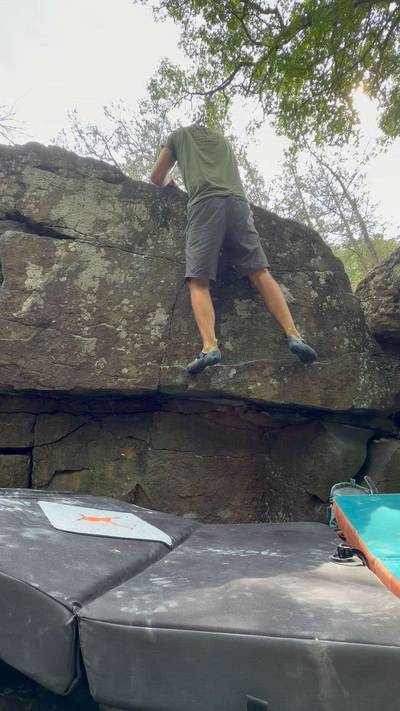
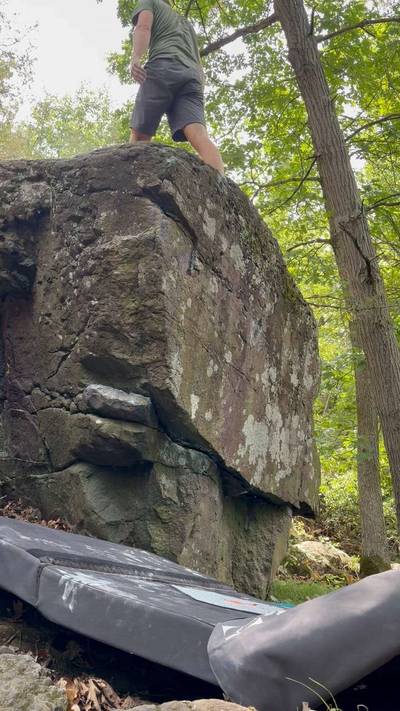
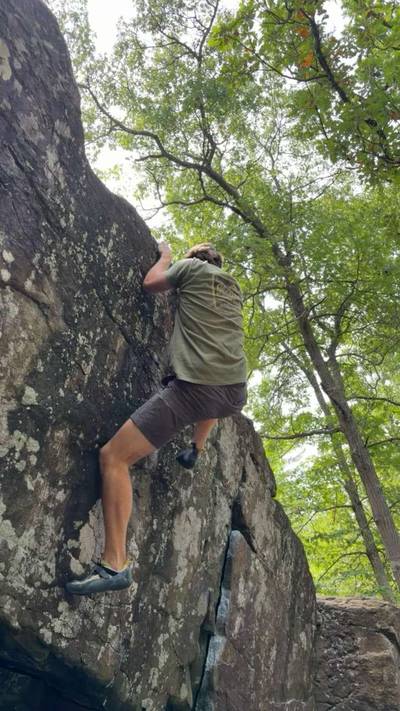
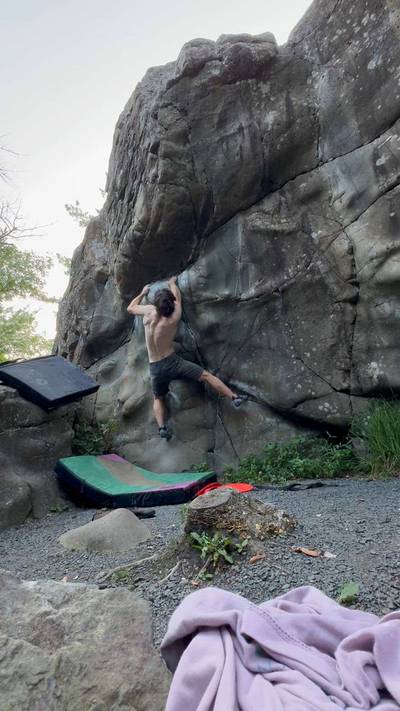
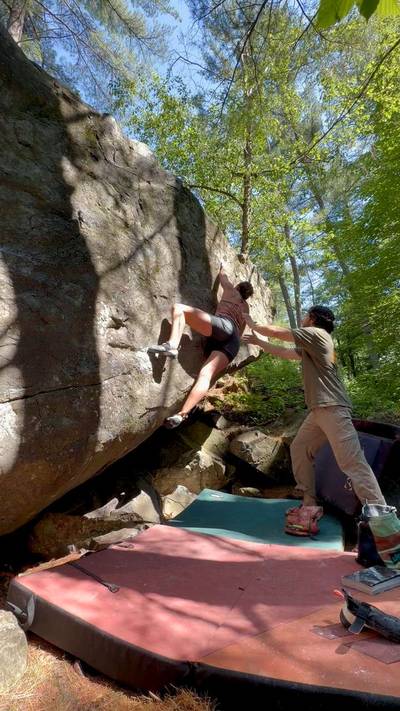
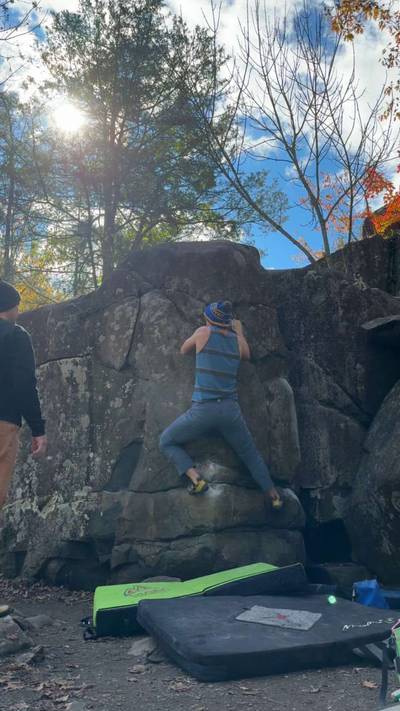
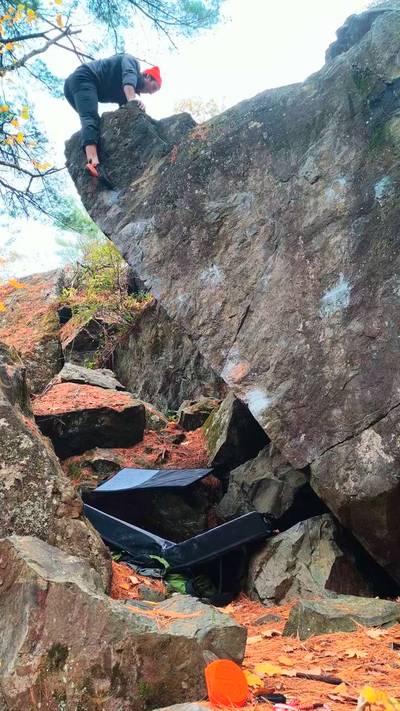
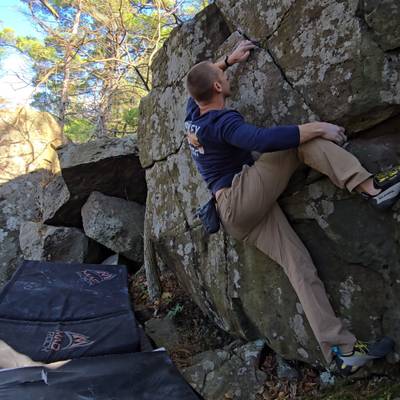
Swimming in the river is not allowed by either Interstate Park—Minnesota or Wisconsin—and as such, deep water soloing is not OK. Climbing over water filled potholes is no longer allowed, unless it is frozen over. Climbing on or near a road is OK but please make sure not to have any of your crashpads, gear, or spotters on the road while climbing. You can be ticketed for blocking traffic. Tourists are ever present at Taylors Falls and many of the other bouldering areas. You will be a representative of the sport—like it or not—so please be kind and respectful of the space. Crashpads should be kept off walking paths and out of the way of daily park users and hikers.
ABOUT Taylors Falls
This digital Taylors Falls climbing guidebook gives you GPS navigation, verified topos, and beta for hundreds of climbs. Explore classics and hidden gems with offline access to maps, directions, and beta videos. Whether it's your first visit or fiftieth, KAYA makes your Taylors Falls days smoother, safer, and more dialed.

Technically, the climbing is located in Interstate Park, which covers the Wisconsin and Minnesota sides of the St. Croix River, however, most climbers colloquially refer to the area as Taylors Falls, which is the name of the town located at the park entrance on the Minnesota side. Despite the name, Interstate Park, there is little crossover between the two parks’ administrations. The style that defines climbing at Taylors is a subtle application of finesse and power. Slight shifts in body position make the difference between going home with a send or going home empty-h... Show more
This digital Taylors Falls climbing guidebook gives you GPS navigation, verified topos, and beta for hundreds of climbs. Explore classics and hidden gems with offline access to maps, directions, and beta videos. Whether it's your first visit or fiftieth, KAYA makes your Taylors Falls days smoother, safer, and more dialed.
Technically, the climbing is located in Interstate Park, which covers the Wisconsin and Minnesota sides of the St. Croix River, however, most climbers colloquially refer to the area as Taylors Falls, which is the name of the town located at the park entrance on the Minnesota side. Despite the name, Interstate Park, there is little crossover between the two parks’ administrations. The style that defines climbing at Taylors is a subtle application of finesse and power. Slight shifts in body position make the difference between going home with a send or going home empty-handed. This may lead you to feel some of the grades are way out of line, which is partially related to the subtle beta aspect and partially related to the old school ratings, which tend to be as stiff as grandma’s coffee. I say, let history stand, and keep the grades where they are. Remember a bunch of hard drinking guys with EBs for shoes and no crash pads put these lines up. When Bounce and Swim was written for Taylors Falls, the customs of bouldering were not specific about start holds, just start position like sit or stand. As such, we have not included start holds on problems that were first done back then, except when the standard start holds have become well established over time like Cave Traverse V8 or B2 Bomber V4. It is best to consider every line at Taylor’s done. This section of the guidebook is a parsed down version of Bounce and Swim, which was written over 20 years ago, and even that guide did not include all that had been done. Many problems and names have come and gone, search and you may find a lost gem.
Pets
Pets are welcome in Minnesota state parks, as long as they are kept on a leash six feet or shorter and are personally attended at all times. Please do not tie pets up along pathways and leave unattended while you climb. Use caution with pets near the St. Croix River when water levels are high and fast.
Plants
Do not remove vegetation from climbs.
Trash & Graffiti
Keep the park clean and pack out trash. Inform park staff of any graffiti in the climbing area so that it can be removed.
Trails
Use established trails when accessing climbs to keep you safe and to prevent erosion.
Climbing Permits
Climbing areas are restricted by Minnesota State Park Rules (6100.1355 (8) Rock Climbing), and climbing is allowed by permit only. Permits are free and are good for one calendar year. Individuals may obtain a permit at the park office or climbers parking lot self-registration station. You need a permit from each park where you climb.
Beta
Swimming in the river is not allowed by either Interstate Park—Minnesota or Wisconsin—and as such, deep water soloing is not OK. Climbing over water filled potholes is no longer allowed, unless it is frozen over. Climbing on or near a road is OK but please make sure not to have any of your crashpads, gear, or spotters on the road while climbing. You can be ticketed for blocking traffic. Tourists are ever present at Taylors Falls and many of the other bouldering areas. You will be a representative of the sport—like it or not—so please be kind and respectful of the space. Crashpads should be kept off walking paths and out of the way of daily park users and hikers.
Emergency Services
St. Croix Regional Medical Center, 216 S Adams St, St Croix Falls, WI 54024, (800) 828-3627
"History of Taylors Falls
—Doug Dokken
My first visits to Taylors Falls were in the early 1970s. At that point, bouldering was established at Noah’s Arc, The Arm Pit, The Boneyards, Slickslides, and Sizzelfoot areas. Sizzelfoot V5 was a project that must have attracted the attention of several climbers. A major move toward greater difficulty was made in the mid to late 1970s. Climbs such as Lloyd’s V3, Sizzelfoot V5, B2 Bomber V4, and Pigs In Space V7 were done then. Some of the names associated with this push were: Coleman Miller, Tommy Deutchler, Dick Anderson, the Jacobs brothers (Mike and Mark), James Mullen, Dan Ol’Grady, Ken Totachec(sp), Will Gove, and Dick Wildberger. Each of these individuals were a character and a force of nature. Inspired by trips to the Needles and seeing John Gill’s legendary problems and his legendary reputation, they trained and dreamed of putting their own problems up impossible looking overhangs and smooth walls at Taylors. This was a time of exploration of what seemed impossible to the earlier generation. In particular, Coleman Miller made it a long-term project of his to do the first ascent of what is now called Sizzelfoot V5. He was going to name the climb Sisyphus, after the Greek god who was condemned to push a boulder uphill for eternity. Tom Deutchler, a Taylors Falls hardman, legendary mountaineer, and Prince of the D.L.F.A., stepped into the picture and in one day did an ascent of the problem. By virtue of his first ascent, he named the problem Sizzelfoot V5. However, this is not the end of the story. Another excellent climber, James Mullen—part of the first ascent party of Vertigo 5.11+ in the Needles of South Dakota—also claimed to have made the first ascent. He claimed that Deutchler’s ascent was done with one hang. The route was underrated for years as a 5.10+ sandbag. In the late 1980s, Lynn Hill did the route on top rope without a fall and rated it 5.12. In the late 1970s, the Jacobs brothers did the first ascents of a number of problems including Little Sizzler V2, Pigs in Space V7, and the left side of Mike’s Boulder (Mike’s Left V7), named after Mike Jacobs. Where did that bolt come from? They also attempted the right side of Mike’s Boulder. All these 1970s ascents were done with EBs, PAs, RDs, RRs or Shoe-nards, the state of the art climbing shoes of the day. A visiting Jim Holloway did B2 Bomber V4 and Digitalis V4. The quality of the footwear was not nearly as good as it is today. To compensate, people worked on improving their hand strength. Mike Jacobs trained to improve his grip to the point where he could pinch 2 x 10 joists and go hand over hand forward or backward along the smooth, wood joists in his basement. He worked up to this by gluing sandpaper of finer and finer grit onto joists. He then trained on joists with one grit and moved on to the next finer grit as he got stronger until he was traversing smooth joists. Mike talked of compulsively squeezing bathroom scales, with two hands, in hardware stores to measure his squeeze grip; something like 300 lbs. Not bad for a 145 lb climber. In the mid–1980s, Mike Dahlberg did Unseamly on the Wisconsin side of the river—a beautiful route now in a do-not-climb area—and in the late 1980s did Lunge or Plunge V4. In 1988, a new wave of bouldering difficulty was about to begin. The first push was from Scott Backes, Tom Deutchler, and several other people who attempted the Red Wall—now called Joint Project 5.13a. Sidetracked by preparations for a climbing trip to the Himalayas, Scott was unable to complete the project before Mike Dahlberg did the first ascent in the hot summer of ‘88. That October, Doug Dokken top roped 5.8+ in the Sizzelfoot area.
In 1989, two important visitors came to Taylors Falls: Bob Horan and Chris Eklund. Horan (author of the classic three part Colorado: Front Range Bouldering Guide, did the first ascent of Genetic Control 5.13a/V8 in June of 1989. The route/problem had been a project of Nate Postma, who was working a direct line straight up the face—started in 1988. Nate was stymied by linking the lower and final portions of the route. Horan, on a slide/lecture tour across the U.S., visited Taylors in June 1989. After doing a quick warmup ascent of Sizzlefoot V5, he saw Nate’s chalk on the route to the right and wanted to attempt it. Two hours later, after two preliminary attempts on top rope to work out the moves and sequences, he made the first top rope ascent. His was a landmark ascent on the Minnesota side of the river. Chris Eklund’s impact on bouldering in the area was huge, doing numerous first ascents: Left of Lloyd’s V10 (1990), most if not all of the Cave problems on the Wisconsin side of the river, Get to the Point V6 (1990), Mike’s Right V8 (1990) (two different ways), Softer Than Diamonds, Harder than Ice 5.13a, direct starts to Walking On Air 5.10b and Batman 5.10c, the direct start/finish to Joint Project 5.13a, just to mention a small fraction of his efforts. His guidebook to Taylors Falls and St Croix Falls bouldering—Bounce and Swim—lists his contributions and the core four climbing companions: Scott Backes, Kurt Vogelsang, and Doug Dokken. When Chris and his girlfriend Lisa left the Twin Cities in 1994 for Cincinnati, he had built a firm foundation for the current generation of boulderers to train on, build off of, and achieve new standards.
—Nic Oklobzija
From 1994 to 2000, the bouldering boom at Taylors falls slowed. However, during that time, Josh Helke and his brother Mike continued the tradition of hard bouldering. In 2000, Brian Camp, Stephan Bauer, and Jim Merli picked up where the Helkes had left off. Brian added a sit start to the classic Censored V7 in the cave in 2002, and then in 2003, Jim added A Wing & a Prayer V10 to the B2 Pit and the short, yet impossible, Humpty Hump V10. They continued to contribute harder lines like sit starts to Mike’s Left V7, Mike’s Right V8, and Lloyd’s V3. In 2004 Jim established the hardest in the area with This Sporting Life, coming in at V11. By 2006, most of the legends had stopped climbing or moved away to greener pastures. Nic Oklobzija and Chris Hirsch continued attempting to repeat most of the hard lines, while the memory of names and legends faded away from the emerging VE bouldering crowd. In 2007, after spending nearly 110 days trying it, Nic was able to send Left of Lloyd’s V10, making it the 5th ascent. In 2008, Nic was able to get the 2nd ascent of This Sporting Life V11. In 2009, Chris Hirsch made the first ropeless ascent of Genetic Control 5.13a/V8 just before he moved to South Dakota."
From the Twin Cities: Take interstate 35 north to Forest Lake. Take the Hwy 8 exit. No need to worry about which direction on Hwy 8, it only goes east from the interstate. Hwy 8 will take you all the way to the town of Taylors Falls. Before crossing the river at the stoplight in Taylors Falls, turn right for the entrance to the Minnesota side. For the Wisconsin side, continue straight at the stoplight across the river, and exit onto Hwy 35, turning right (south). The entrance will be a half mile down and on the right side of Hwy 35. It is possible, and enjoyable, to walk from state to state via the Hwy 8 bridge.
A parking pass is needed to park in either state park, but your Minnesota Parks Pass will not work in Wisconsin and vice versa. Minnesota requires a climbing permit—which is free and can be obtained from the Visitor Center—Wisconsin does not. There is also free parking behind the gas station but this does add a longer approach/warmup to the boulders.
Explore Taylors Falls from all levels with KAYA PRO. Drill down to the area, subarea, boulder and climb levels. Get approach information for each, and a variety of beta.