
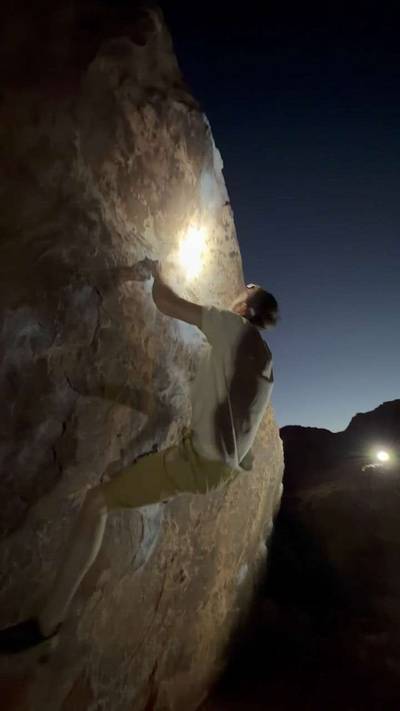
Kraft, Red Rock
Red Rock Climbing

Last Updated: Sep, 2026
28,936
Ascents
2,789
Boulders
333
Routes
Guide moderated by Jason Fisher & SNCC
ABOUT Red Rock
This digital Red Rock climbing guidebook gives you GPS navigation, verified topos, and beta for hundreds of climbs. Explore classics and hidden gems with offline access to maps, directions, and beta videos. Whether it's your first visit or fiftieth, KAYA makes your Red Rock days smoother, safer, and more dialed.

Red Rock Canyon, one of North America's premiere climbing destinations, has a rich history alongside other well-known crags such as Hueco Tanks, Yosemite, Bishop and Joshua Tree, dating back to the mid-1970s. It has been extensively explored and documented through numerous legends over the decades and Tom Moulin's comprehensive paper guidebook for Red Rock and the other Southern Nevada crags is one of the best bouldering guidebooks in the world. There have been many iterations over the 2000s with the latest being available here: https://www.snellpress.com/snb3.

Located just 10 ... Show more
This digital Red Rock climbing guidebook gives you GPS navigation, verified topos, and beta for hundreds of climbs. Explore classics and hidden gems with offline access to maps, directions, and beta videos. Whether it's your first visit or fiftieth, KAYA makes your Red Rock days smoother, safer, and more dialed.
Red Rock Canyon, one of North America's premiere climbing destinations, has a rich history alongside other well-known crags such as Hueco Tanks, Yosemite, Bishop and Joshua Tree, dating back to the mid-1970s. It has been extensively explored and documented through numerous legends over the decades and Tom Moulin's comprehensive paper guidebook for Red Rock and the other Southern Nevada crags is one of the best bouldering guidebooks in the world. There have been many iterations over the 2000s with the latest being available here: https://www.snellpress.com/snb3.
Located just 10 minutes away from Summerlin and 25 minutes away from the Las Vegas Strip and Harry Reid International Airport, it is easily accessible to Las Vegas locals, domestic and international travelers alike. With over 2500 currently eastablished boulder problems across all grades (yes even V17), and such ease of access, it is one of the most traveled rock climbing destinations in the world. Containing world-class classics at every grade and of every climbing-style imaginable, spread across over 15 different canyons with varying levels of popularity, Red Rock provides something for everyone. You can choose to climb classics with a long legacy and short approaches in areas like Kraft and Red Spring, or go off-the-beaten path in remote canyons like Mud Springs and Mustang. Whichever you choose, remember to follow leave-no-trace and general respectful best practices:
- Stay on designated trails. Red Rock Canyon is a National Conservation Area managed by the Bureau of Land Management with over 3 million visitors a year. BLM, Park Rangers, SNCC and locals spend time building designated trails to preserve and restore wildlife habitat, natural resources, and prevent unnecessary erosion.
- The vast majority of rock type in all of Red Rock Canyon is the type of Aztec Sandstone which is prone to breaking after rain. Depending on how much rain has accumulated, do not climb for anywhere from 24-72 hours. The Southeastern side of Las Vegas does have some climbing alternatives after rain, such as Big Sandy or Keyhole Canyon, although of considerably less quality than Red Rock. Gyms in town such as Red Rock Climbing Center and The Refuge are also options.
- Be mindful of all other visitors enjoying and admiring what Red Rock has to offer. Depending on where you choose to climb, you will likely run in to many climbers and non-climbers alike enjoying the beauty that Red Rock has to offer. This includes monitoring pets especially in crowded areas like Kraft, Red Spring, First Pullout and Willow Springs.
Located within the desert the weather and climbing season of Red Rock favors the Winter months. The most prime days ranging from November-March, with shoulder-season climbing possible in September/October and April/May if you're willing to chase shade. It is common to have stretches of rainy days and weeks even during the prime months, where climbing becomes no longer possible until the sandstone dries.
- Pay attention to designated boulders that have been marked off limits and closed for various reasons. This includes, but is not limited to, the Birthing Boulder in Kraft with the old-school classic Caliman V7, any climbs near the Red Spring Boardwalk, including the modern testpiece Tourist Trap V9, another old school classic Desert Rain V10 in First Pullout, as well as Ambacamba V10 near the Fish Head in Windy Canyon. All generally closed due to proximity to Native American Rock Art, protected under the Archaelogical Resources Protection Act.
Red Rock Canyon bouldering is generally categorized into four areas:
1. The zones within the Calico Basin are the first you approach from Charleston Blvd as it transitions into SR159. You turn right onto Calico Basin Rd to access either the Red Spring, Calico Basin, Kraft or Gateway Canyon boulders via designated parking spots. These areas are free of charge to access, the most popular and densely crowded. Kraft, Calico and Red Spring generally have short approaches with some outliers, and Gateway is farther in. Park only in designated spots, and be prepared to find alternative locations if parking is full, especially during the prime months of the season.
2. The majority of Canyons are within the 13-mile Red Rock Canyon Scenic Loop which is more restrictive to climb at. A timed reservation booked through recreation.gov is required from October 1st to May 31st and the entry gate is only open from 8am-5pm. There is a $2 fee for every reservation, and either a $20 per-day entry fee or an annual pass such as America the Beautiful or Red Rock. Reservations tend to get full during prime-time slots. The zones accessed through this loop are First Pullout, Second Pullout, Sandstone Quarry, White Rock Springs, Willow Springs, Ice Box Canyon, Pine Creek Canyon, Juniper Canyon, and Oak Creek Canyon. First Pullout can be accessed from outside the loop via Red Spring with more hiking, and Oak Creek Canyon can be accessed from outside the loop via Middle/South Oak Creek Trailhed with more hiking. The 13-mile loop is one-way, thus once you go past a particular zone, you cannot go back to it without a new reservation and re-entering the loop. Do not stay past dusk.
3. South Oak Creek Canyon near Mount Wilson and First Creek Canyon are accessed via designed parking lots past the exit of the Red Rock Canyon Scenic Loop on SR159. They are free of charge and you do not need to drive through the loop.
4. Southern Outcrops, Windy Canyon, Mud Springs Canyon, Black Velvet Canyon and Mustang Canyon are all accessed via SR160 south of SR159. Most easily accessible through different road forks off of the Late Night Trailhead, each with their own designated parking spots, these generally require cars with good ground clearance, but the flattened level of the dirt roads can change from season to season. There is no charge for climbing in these canyons.
OFFLINE MAPS + APPROACH


Get the full experience in the app.
Download KAYA
Recent Beta Videos
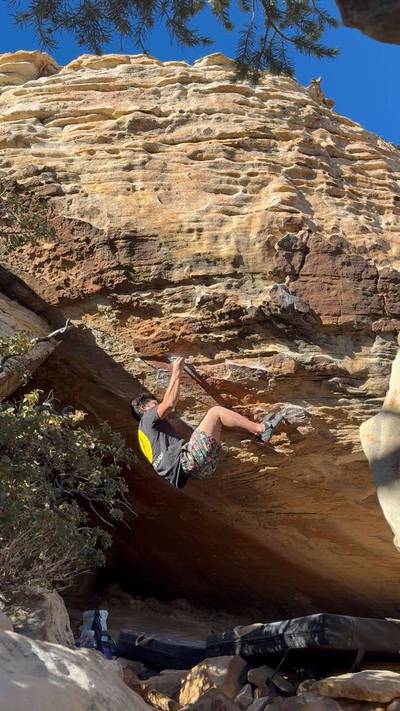
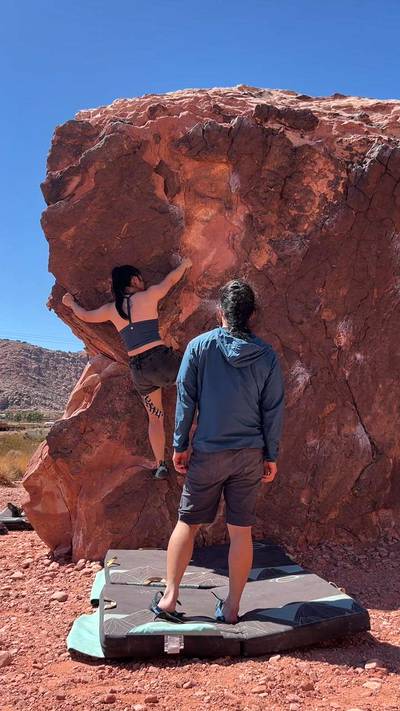
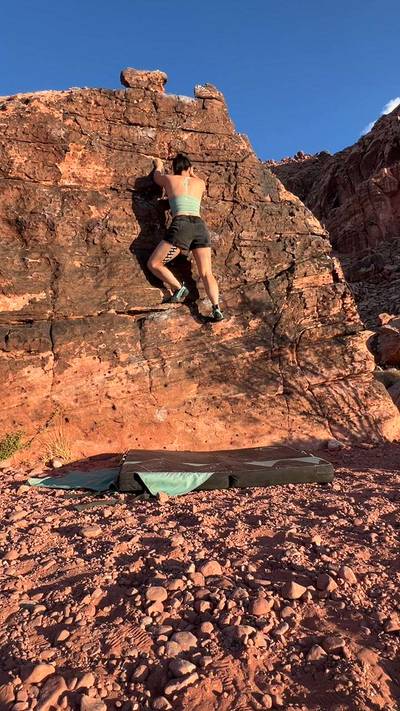
LOAD MORE
Search Red Rock Climbs
Name
Grade
Area
# of Ascents
Rating
Potato Chips
v2
Kraft
884
4.4
(884)
Solid
Monkey Bars
v2
Kraft
644
4.6
(644)
Solid
Sorange
v3
Kraft
578
4.4
(578)
Solid
Monkey Wrench
v7
Red Spring
549
4.1
(549)
Solid
Poker Chips
v1
Kraft
541
4.3
(541)
Solid
The Wave
v3
Kraft
532
4.2
(532)
Solid
The Pearl
v5
Kraft
516
3.9
(516)
Solid
Jones'n
v4
Kraft
489
4.2
(489)
Solid
Equinox
v6
Red Spring
441
4.1
(441)
Solid
Welcome to Detroit
v4
Kraft
396
3.7
(396)
Solid
The Pork Chop
v3
Gateway Canyon
390
4.6
(390)
Solid
Monkey Bar Right
v6
Kraft
367
4.1
(367)
Solid
Butterfly Kiss
v3
Kraft
339
4.2
(339)
Solid
Umpa Lumpa
v5
Kraft
304
4.2
(304)
Solid
Plumber's Crack
v1
Kraft
263
4.8
(263)
Solid
Jenna's Jewelry
v4
Kraft
262
3.7
(262)
Solid
Spitting Venom
v8
Kraft
253
3.7
(253)
Solid
Bubble Butt
v7
Kraft
251
4.2
(251)
Solid
Monkey Bar Direct
v8
Kraft
245
4.0
(245)
Solid
Showing results: 1 - 19
Recent Ascents in Red Rock
KAYA CLIMBER
CLIMB
DETAILS
DATE
Showing results: 1 - 5
WEATHER
SEASON CHART
APPROACH
Forecast for Red Rock
Areas in Red Rock
Explore Red Rock from all levels with KAYA PRO. Drill down to the area, subarea, boulder and climb levels. Get approach information for each, and a variety of beta.
Download KAYA
Bouldering
Black Velvet Canyon
Calico Basin North
Calico Basin South
First Creek Canyon
First Pullout
Gateway Canyon
Ice Box Canyon
Juniper Canyon
Kraft
Mud Springs Canyon
Mustang Canyon
Oak Creek Canyon North
Oak Creek Canyon South
Pine Creek Canyon
Red Spring
Sandstone Quarry
Second Pullout
Southern Outcrops
White Rock Springs North
White Rock Springs South
Willow Springs
Windy Canyon